
This week, three studies shake up our understanding of the climate. Invisible wetlands are emitting more methane than we thought. Fires are undoing decades of air quality improvement. And science shows that taking care of the land can benefit everyone at once.
In this edition: Small wetlands account for 24% of methane emissions from non-forested wetlands. Wildfires are reversing a decade of ozone improvement in the U.S. An analysis of 146 countries reveals simultaneous gains in biodiversity, climate, and the economy.
Small wetlands emit more methane than anyone calculated
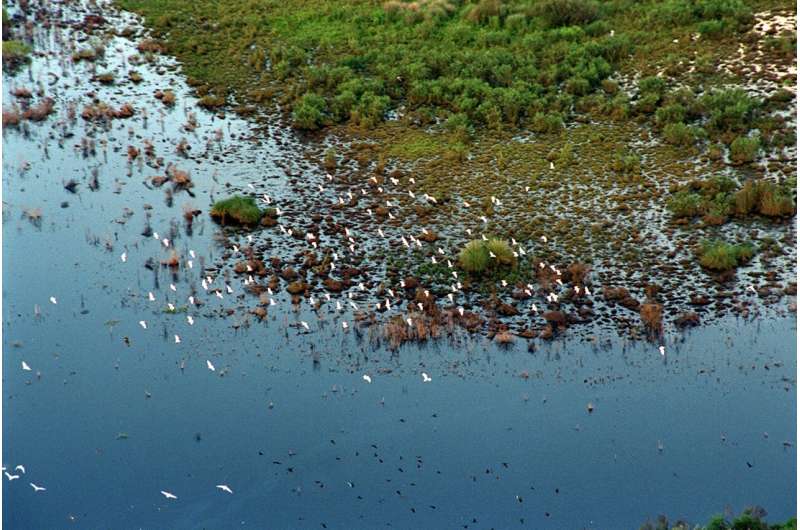
Wetlands are the planet's largest natural emitter of methane. Swamps, peatlands, and salt marshes constantly release this potent greenhouse gas. But climate models have always ignored the smaller ones. A new study from the University of Texas at Austin changes that.
The 24% that no one had accounted for
Researchers identified tens of millions of small wetlands scattered across the globe. Their conclusion is clear: together, they account for 24% of total methane emissions from non-forested wetlands. These areas are so small that they barely show up on maps. The study is published in Nature Climate Change and compels a review of global greenhouse gas inventories.
📎 Read the full article on Phys.org
Fires erase a decade of ozone improvement in the US.
For years, environmental regulations reduced tropospheric ozone in the United States. It was a real and measurable success. But a new study published in Science reveals that this achievement is unraveling. The work is led by researchers from the University of Iowa.
Wildfires and Air Pollution Transport: The Double Threat
The study is titled «Wildfires Reverse Progress Towards US Ozone Air Quality Standards.» Wildfires and the long-range transport of polluted air are to blame for the setback. Ground-level ozone harms lungs and vegetation. As fires intensify due to climate change, protecting air quality becomes increasingly difficult.
📎 Read the full article on Phys.org
Using land better benefits the climate, biodiversity, and the economy.
Conserving nature and growing economically are always presented as incompatible goals. An interdisciplinary team from the University of Minnesota challenges this idea. They analyzed 146 countries to identify where and how to improve land management. Their results are published in Science.
Simultaneous Gains: Climate, Nature, and Development
This is the first analysis of its kind on a global scale. Researchers found significant potential gains in biodiversity, climate, and economic development from improved land use management. There is no need to choose between conservation and growth. The study offers a concrete roadmap for governments and multilateral institutions worldwide.
📎 Read the full article on Phys.org
What's coming next week?
We will closely follow the data on wetlands methane fires and its impact on global climate models. Science moves fast. So do we. Follow Canal Meteo TV to stay up-to-date.
For more official weather information, consult the National Weather Service (NWS) hello National Oceanic and Atmospheric Administration.
Explore more articles at Meteo TV Channel.
 Español
  English