The Atlantic is sending a worrying signal: the AMOC continues to weaken. In the U.S., wildfires are erasing a decade of air quality improvements. And the world's smallest wetlands are proving to be big methane emitters.
In this edition: The Atlantic "cold spot" points to a weakening AMOC, according to a new study in Geophysical Research Letters. Wildfires are reversing years of progress against ozone pollution in the U.S., according to Science. Small, overlooked wetlands account for 24% of natural methane emissions, according to Nature Climate Change.
The cold patch of the Atlantic reveals a weakened AMOC

For 150 years, the entire surface of the planet has warmed. The entire surface, except for one area. Southeast of Greenland, there is a region that has cooled by up to 1°C. Scientists call it the «cold blob.» Stefan Rahmstorf, from the Potsdam Institute for Climate Impact Research, has led a new analysis based on real data: satellites, buoys, and ships. His results point to a weakened AMOC.
The cooling reaches a depth of 1,000 meters
The team found that surface heat loss in the region has decreased since 1955. Furthermore, the cooling is not only superficial: it reaches a depth of 1,000 meters. That rules out winds as the primary cause. Only weaker ocean circulation explains this pattern, the authors argue. The study is published in Geophysical Research Letters.
The subpolar gyre: another alert for Europe
Rahmstorf goes beyond the AMOC. He warns about the subpolar gyre, a large circular current around the cold patch. This current feeds the sinking of dense water that drives the AMOC. If it collapses, it could cool northwestern Europe faster than a total collapse of the AMOC. «The subpolar gyre crossing this tipping point could generate serious climate impacts in Western Europe as early as the 2040s,» says Rahmstorf. Other researchers, such as David Thornalley of University College London, acknowledge the value of the work but warn that it is not yet the final word.
📎 Read the full article in New Scientist
Fires reverse a decade of ozone improvement in the US.
Ozone pollution has worsened in much of the U.S. over the last decade. That's according to a University of Iowa study published in Science. The paper is titled «Fires reverse progress toward ozone air quality standards in the U.S.» The culprits are wildfires and the long-distance transport of polluted air.
Ozone travels far from the fire
Ground-level ozone is harmful to the respiratory system. Decades of regulations led to its sustained reduction. However, wildfires emit large amounts of ozone precursors. The wind carries them hundreds of kilometers. Regions without nearby wildfires receive this polluted air. This undoes in a short time what took years to achieve.
📎 Read the full article on Phys.org
Small wetlands account for 24.1% of global natural methane emissions
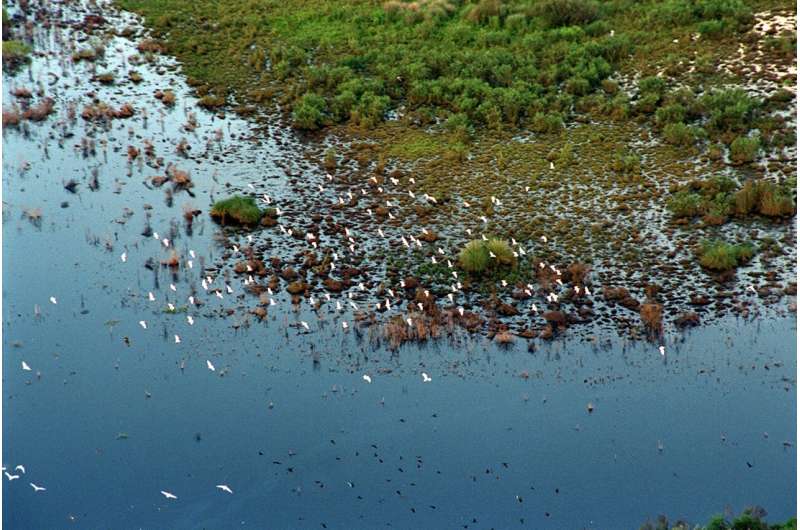
Wetlands are the planet's largest natural source of methane. Marshes, peatlands, and swamps release this potent greenhouse gas. But climate models have always ignored the smallest ones. A team from the University of Texas at Austin changed that. Their study, published in Nature Climate Change, identified tens of millions of small wetlands scattered around the world.
A 24% that is changing global inventories
The collective impact of these wetlands is much greater than previously assumed. Together, they account for 24% of all methane emissions from non-forested wetlands worldwide. Without including them, global methane inventories underestimate natural emissions. And that directly affects models of future warming. Incorporating these small wetlands into climate calculations is no longer optional.
📎 Read the full article on Phys.org
What's coming next week?
The AMOC Atlantica weakening will remain one of the topics to watch in the coming months. Each new study adds a piece to a complex puzzle. We will continue to tell you about the science behind the major changes in the climate system. Don't miss the next edition of Canal Meteo TV.
For more official weather information, consult the National Weather Service (NWS) hello National Oceanic and Atmospheric Administration.
Explore more articles at Meteo TV Channel.